
🎧 Busy Parent? Listen to the Quick Summary (5 mins)
The Unwavering Guardian: Why Fabric is Your Child's Best Defense
When it comes to protecting children from the sun's damaging ultraviolet (UV) radiation, the conversation often begins with sunscreen. However, a growing body of scientific evidence and dermatological consensus points to a more reliable and effective solution: sun-protective clothing. Acting as a physical barrier, purpose-built apparel is the single most effective way to shield a child's delicate skin from harm.1
While a comprehensive sun safety strategy includes shade and correctly applied sunscreen—a topic we explored in-depth in our The Ultimate Guide to Child Sun Safety in Australia —this guide focuses on the "first line of defence": your child's wardrobe.
The superiority of fabric over lotions is not just a matter of convenience; it is a matter of consistency. A landmark study from Oregon Health & Science University (OHSU) positions Ultraviolet Protection Factor (UPF) clothing as the "cornerstone of UV protection."2 Unlike sunscreen, which can be wiped off, sweated off, or applied too thinly, UPF clothing offers a guaranteed level of protection for all covered areas from the moment it is put on.1 For parents, this removes the variable of human error, providing a tangible sense of security that is simply unmatched.
Decoding the Science: A Parent's Guide to Understanding UPF
Navigating the aisles of children's swimwear can feel like deciphering a complex code. Understanding the science behind the labels is the first step toward making empowered, informed purchases, regardless of which brand you choose.
UPF vs. SPF: Clearing the Confusion
The two most common ratings parents encounter are UPF and SPF. While they sound similar, they measure fundamentally different things.
-
SPF (Sun Protection Factor) is used for sunscreens and measures how long it takes for UV-exposed skin to redden.4 It primarily gauges protection against UVB rays (burning rays).
-
UPF (Ultraviolet Protection Factor) is the standard for fabric. It indicates how much UV radiation—both UVA and UVB—a fabric allows to reach the skin.6
This distinction is critical. UPF-rated fabrics are tested for their ability to block broad-spectrum radiation. The OHSU study found that while UPF fabrics blocked 96-98% of harmful UVA (ageing/long-term damage) rays, some sunscreens blocked significantly less.2 This makes UPF clothing essential for preventing invisible, long-term damage.
The UPF Rating Scale: What to Look For
When shopping for your child's swim and play wear, look for the hangtag indicating the UPF rating.
|
UPF Rating |
Protection Category |
% UV Radiation Blocked |
|
15–24 |
Good |
93.3–95.9% |
|
25–39 |
Very Good |
96.0–97.4% |
|
40–50+ |
Excellent |
97.5–98%+ |
The Gold Standard: Always aim for UPF 50+. This rating ensures that less than 2% of UV rays penetrate the fabric.8 In contrast, a standard white cotton t-shirt may have a UPF as low as 5, which drops even further when wet.10
Parent Pro-Tip: The "Hold It Up to the Light" Test
If you are buying everyday clothing that doesn't have a specific UPF rating on the label, you can perform a simple field test. Hold the garment up to a bright light or the sun. If you can see light shining through the weave easily, UV rays can penetrate it just as easily.11 Tighter weaves, darker colours, and synthetic blends (like polyester and nylon) generally offer better protection than loose, light-coloured cottons.6
Building the Perfect Sun-Safe Wardrobe: A Buying Checklist
Since KidsBliss focuses on the essential skin-care side of sun safety, we want to empower you to find the best clothing to pair with our products. Here is your expert checklist for buying swimwear and hats from your favourite retailers.
1. Swimwear: Coverage is Key
For days at the beach or pool, "rashies" (rash vests) and sunsuits are non-negotiable.
-
Style: Look for high necks and long sleeves. A full-body sunsuit reduces the amount of exposed skin you need to chase with sunscreen.14
-
Features: Look for front zippers (easier to get on and off a wet child) and, for toddlers, snap clips at the crotch for easy nappy changes.15
-
Fabric: Ensure the label explicitly states chlorine-resistant to ensure the UPF rating doesn't degrade after a few trips to the pool.17
2. The Hat Hierarchy
Not all hats are created equal. According to the Cancer Council, baseball caps are not recommended because they leave the ears, neck, and cheeks exposed.18
-
Best: Broad-brimmed hats (at least 6cm brim for kids) or Legionnaire hats (with the back flap).
-
Better: Bucket hats with a deep crown and angled brim (at least 5cm).
-
Avoid: Caps and visors.18
3. Sunglasses: Safety, Not Just Style
Sunglasses for kids are often treated as toys, but they are vital safety equipment.
-
The Standard: Only buy sunglasses labelled as complying with Australian Standard AS/NZS 1067:2016.19
-
The Category: Look for Lens Category 2 or 3. Category 0 and 1 are fashion spectacles and provide low sun glare reduction.19
-
The Fit: Wrap-around styles are best as they stop UV rays from entering the eye from the sides.20
Completing the Armour: The "Gap Protection" Strategy
You have the UPF 50+ sunsuit, the broad-brimmed hat, and the certified sunglasses. You might think you are done—but clothing has gaps.
The "gaps" are the areas that clothing cannot cover: the face, the back of the hands, the tops of the feet, and the ankles. These are high-risk areas often missed by parents. This is where KidsBliss steps in to complete the safety circle.
The Seal: KidsBliss Organic Mineral Sunscreen (SPF 50 & PA++++)
Think of your child's sunsuit as the shield and our sunscreen as the seal. However, not all sunscreens are created equal. While many parents look for SPF 50, there is another rating you need to know: PA++++. (See our blog: The 2025 Australian Parent's Definitive Guide: Choosing the Safest and Most Effective Sunscreen for Your Child.)
-
Beyond Burning (SPF vs. PA): SPF primarily measures protection against UVB rays (the ones that cause red burns). But the sun also emits UVA rays, which penetrate deeper and cause invisible, long-term damage and ageing. The PA system measures protection against these UVA rays.
-
Why PA++++ Matters: PA++++ is the highest possible rating for UVA protection. It offers significantly higher defence against long-term cellular damage than sunscreens with lower or no PA ratings.
-
The KidsBliss Advantage: Our Organic Baby & Kids Mineral Sunscreen combines SPF 50 (Maximum UVB defence) with PA++++ (Maximum UVA defence). Use it to create a "gloves and socks" barrier on hands and feet, and a protective mask on the face and neck where the hat brim's shade might not reach.
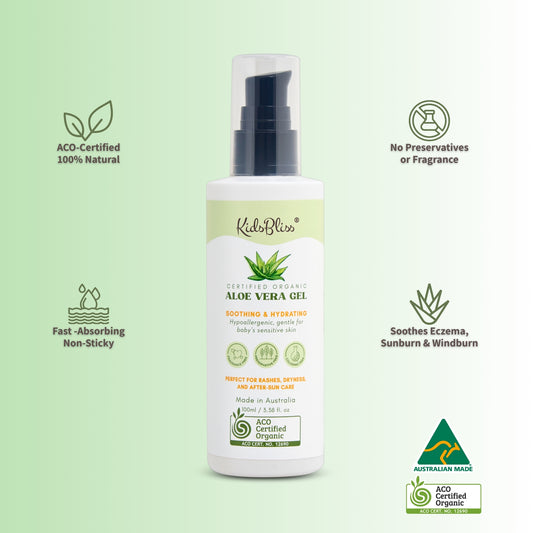
The Soothe: KidsBliss Organic Aloe Vera Gel
Even with the best protection, heat, sweat, and salt can irritate delicate young skin. A day in a wetsuit or rashie can sometimes lead to heat rash or friction rub.
-
Post-Sun Recovery: After the swimwear comes off, applying our ACO Certified Organic Aloe Vera Gel provides immediate hydration and cooling relief. It’s the perfect way to reset your child’s skin barrier after a long day of outdoor play.21
Conclusion: A Partnership for Protection
Sun safety is not about one single product; it is a system. By combining high-quality UPF clothing from trusted apparel brands with the rigorous skin protection of KidsBliss Mineral Sunscreen, you create a complete defence system against the harsh Australian sun.
Dress them in the best armour you can find, and seal the gaps with confidence.